
Key takeaways
- Use AI CCTV analytics to detect forklift–pedestrian proximity risk and improve traffic discipline.
- Reduce shrinkage by monitoring after-hours movement, tailgating, and restricted-zone access.
- Improve productivity by measuring dock congestion, aisle bottlenecks, and response time to exceptions.
Table of contents
Warehouses run on speed and predictability—but the environment is also full of moving equipment, tight aisles, blind spots, and constant shift changes. If your site relies on CCTV alone, you likely have footage for investigations but limited real-time intervention.
AI CCTV analytics for warehouses turns video into actionable events: safety alerts, security exceptions, and operations reporting. It reduces the need for constant manual monitoring while improving consistency across gates, docks, aisles, and restricted areas.
What is AI CCTV analytics for warehouses?
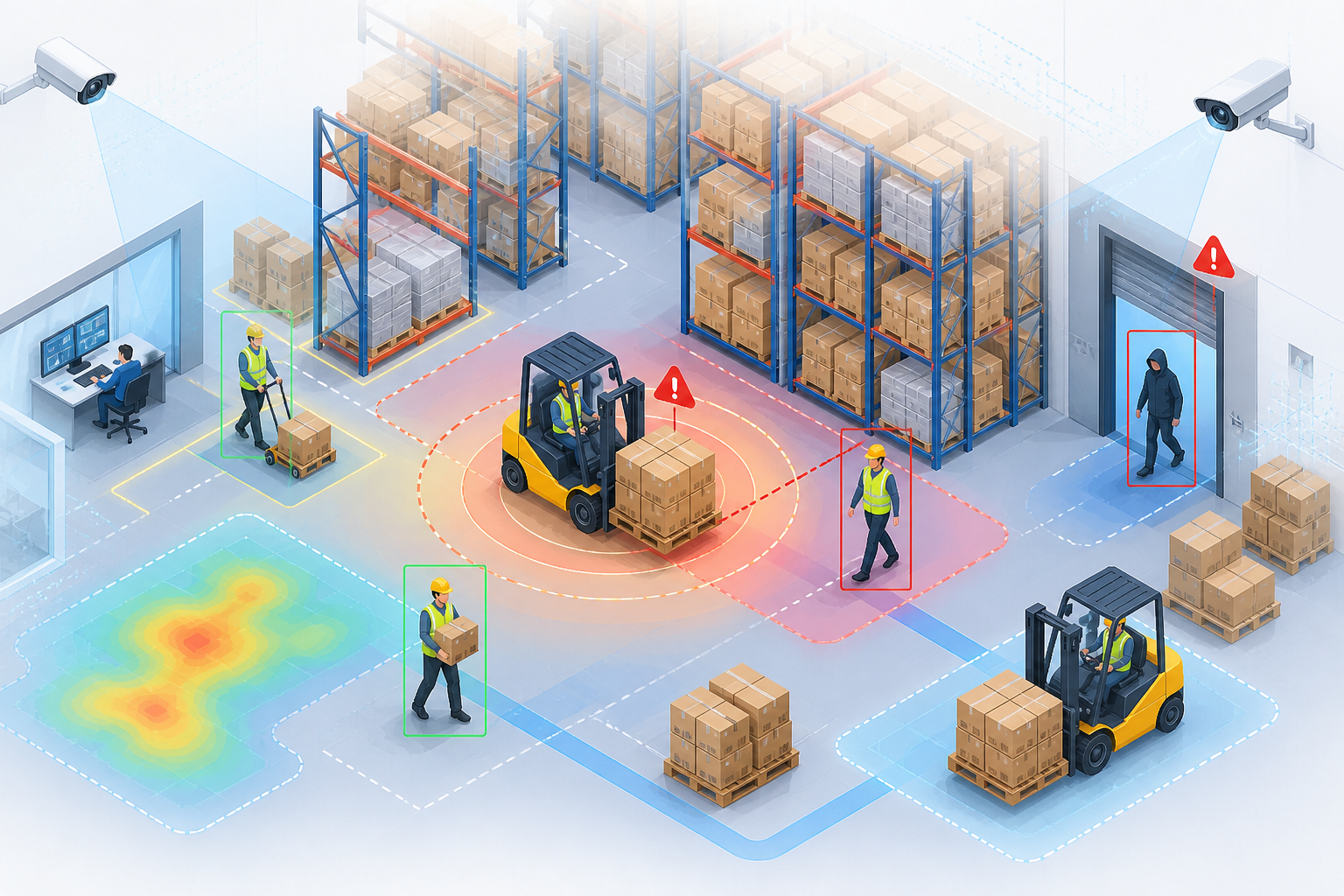
AI CCTV analytics uses computer vision to understand what’s happening in camera feeds. Instead of watching screens all day, teams define zones and rules (for example: “no pedestrian in forklift lane” or “movement after hours”), then the system detects violations and produces alert evidence (images/clips) and shift-level reports.
In simple terms
It turns CCTV into a real-time exception system: the AI watches continuously and only surfaces the moments that matter for safety, security, or throughput.
Why warehouses need AI monitoring
- Forklift exposure: near-misses happen quickly, especially at corners and intersections.
- Security + shrinkage risk: tailgating and after-hours movement are hard to police consistently.
- Operational blind spots: congestion at docks or staging areas reduces throughput.
- Limited supervisory bandwidth: teams can’t be everywhere across multiple zones.
Forklift safety monitoring (high ROI starting point)
The biggest safety wins usually come from managing forklift–pedestrian interaction risk. AI can track people and forklifts, monitor defined lanes, and detect unsafe proximity events. The outcome is fewer near-misses, stronger traffic discipline, and clearer safety coaching with visual evidence.
- Proximity events: highlight close approaches between forklifts and pedestrians.
- Wrong-way movement: detect equipment moving against one-way rules (where applicable).
- Restricted lanes: flag pedestrians in forklift-only corridors and intersections.
Intrusion detection and restricted-zone monitoring
Warehouse security issues often happen at gates, side doors, loading bays, and high-value storage zones. AI analytics can detect after-hours movement, tailgating, unauthorized entry into restricted zones, and suspicious loitering around sensitive areas.
The key is to define zone logic that matches your operations: strict rules for after-hours windows, higher tolerance during shift changes, and escalation only for repeated or high-severity events.
Productivity visibility without extra hardware
Video analytics can also support operational visibility—especially where teams struggle with congestion or inconsistent process flow. Instead of relying on anecdotal observations, you can generate shift-level indicators for where time is being lost.
- Dock congestion: measure crowding or queue build-up near bays and staging areas.
- Aisle bottlenecks: identify recurring choke points that slow movement.
- Exception response time: measure time-to-acknowledge for alerts and operational issues.
Deployment blueprint (simple, scalable)
- Camera audit: confirm coverage for gates, docks, intersections, and restricted zones.
- Zone mapping: draw forklift lanes, pedestrian walkways, and no-go areas.
- Start with 2–4 rules: forklift proximity + after-hours movement + one restricted zone.
- Tune thresholds: reduce false positives before expanding to more cameras.
- Operationalize reporting: weekly summaries for safety and security leadership.
Camera placement checklist
- Intersections + blind corners: highest forklift–pedestrian risk zones.
- Dock doors + staging: congestion and after-hours movement hotspots.
- Entry/exit points: tailgating, unauthorized access, and time-window exceptions.
- Restricted zones: high-value inventory or hazardous areas.
KPIs to prove impact
- Unsafe proximity events: per shift by zone/intersection.
- Restricted-zone violations: by time window (shift vs after hours).
- After-hours exceptions: incidents outside approved windows.
- Response time: detection-to-acknowledgement and time-to-resolution.
- Congestion indicators: queue duration at docks or staging areas.
How CoCompanionAI supports warehouse CCTV analytics
CoCompanionAI helps warehouses turn existing cameras into real-time safety, security, and operations workflows. Teams can define zones, set rules, route alerts, and produce shift-level compliance and exception reporting—without adding operational complexity.
If you’re new to the topic, start here: What is video analytics?
Related guide: Construction site monitoring with AI video analytics
Frequently Asked Questions (FAQ)
What is AI CCTV analytics for warehouses? ▾
Do warehouse video analytics systems work with existing CCTV cameras? ▾
How can AI reduce forklift accidents in warehouses? ▾
Where should warehouse cameras be placed for best analytics results? ▾
How do teams avoid alert fatigue in warehouse monitoring? ▾
What KPIs should warehouses track with AI CCTV analytics? ▾
Conclusion
AI CCTV analytics makes warehouses safer and more predictable. Start with forklift safety monitoring and after-hours security, then expand to productivity visibility as your zones and thresholds mature.
Book a walkthrough
See warehouse CCTV analytics on your cameras
Schedule a 30-minute session to review your layout, define zones, and see how CoCompanionAI fits your safety and security workflow.